
You may ask yourself- “Why I feel empty even when life is going fine?”
Thank you for reading this post, don't forget to subscribe!Sometimes you feel empty even when you do all the things you are supposed to do.
There is no reason for you to feel as lonely and lost as you do. But you feel that everything in your life is superficial.
Psychologists have always emphasized the importance of having positive relationships. But you may have people in your life and a beautiful career, but you don’t feel happy.
It shows that you are covertly avoiding your own life. This is known as covert avoidance. It is an elusive and deep-seated form of avoidance common for people with adverse childhood experiences, such as abandonment and emotional neglect.
Sometimes you do everything right, but it still doesn’t give you a sense of happiness and meaning.
Some people during their childhood might have learnt to become avoidant to protect themselves emotionally and psychologically. Due to their experiences, they remain frozen as fragile children forever terrified of rejection, judgment, and abandonment.
When you grow up, you build your life around these fears, avoiding anything that might trigger them.
You don’t form deep emotional attachments with people, pursue your dream jobs, or take that risk we’ve always wanted to. But still you pretend that everything is fine.
Such behaviour gives temporary relief from anxiety, shame, and other uncomfortable feelings. But remember this is an unhealthy form of coping, and it can have detrimental consequences.
If you protect yourself too much, that destroys you too, and you risk falling apart. Your development gets frozen, and you feel like a sad child wandering around.
The behaviour reflects an extreme kind of anxiety and social avoidance. It is a noticeable behaviour.
Covert avoidance is not visible to many people because you are more or less interacting with the world, but you are on a lot of levels holding yourself apart.
Sometimes you don’t notice this behaviour as you are too busy or too tired all the time to do normal things.
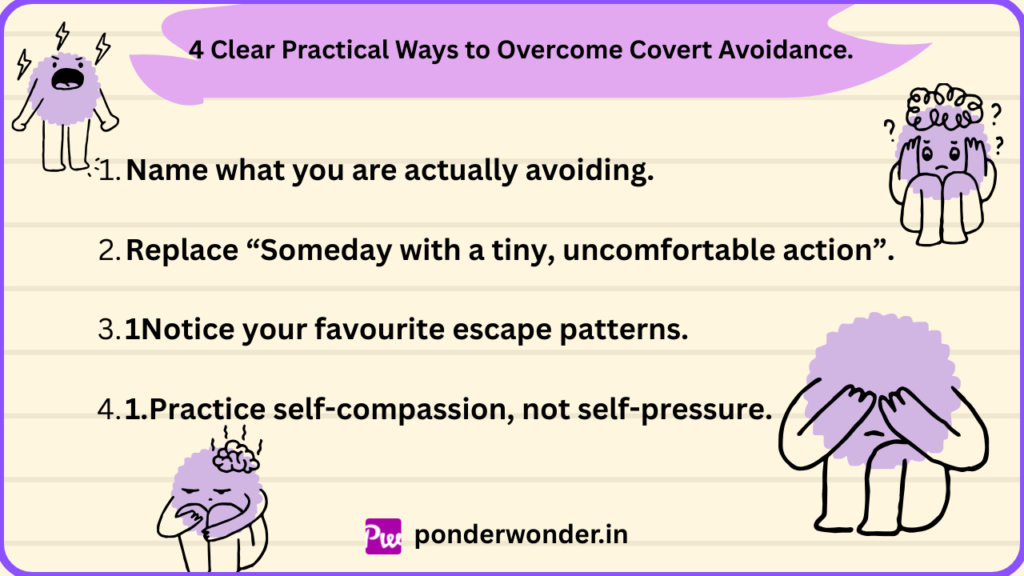
Here are 4 Clear Practical Ways to Overcome Covert Avoidance:-
1. Name what you are actually avoiding.
Covert avoidance hides behind busyness and overthinking. You can ask yourself, ” What discomfort am I trying not to feel?”
- Name the discomfort – For instance, facing a relative with a smile who once criticized you.
- Now that you are aware of the fear, it gives you courage to face it.
2. Replace “Someday with a tiny, uncomfortable action.”
You can overcome avoidance with micro-courage.
- Instead of:
- I’ll do when I am ready.
- I’ll think about it more.
- I’ll talk some other day.
- Do:
- One honest conversation.
- One difficult decision.
Small steps will train your brain to tolerate discomfort in installments.
3. Notice your favourite escape patterns.
Everyone has a go-to distraction.
- Showing busyness.
- Excessive planning.
- Helping others instead of yourself.
- Talking a lot to show that you are fine.
- Scrolling but not watching.
- Reading but not understanding.
Don’t judge yourself. Just observe: “This is my escape route.”
This pause gives you the power to make a choice. It gives you the power to face your fear like a warrior.
4. Practice self-compassion, not self-pressure.
When we do harsh self-talk, it increases our fears and makes it difficult to overcome covert avoidance.
- The rule is to be kind to yourself.
- Engage in a gentle self-talk.
- “I am avoiding this because it is difficult and it’s human.”
- Do not engage in self-criticism.
It is when you replace shame with safety, that you are able to take action.
Also Read:-
- Mindfulness for Students in a Stress-Filled World
- The Secret Habit Stacking 4 Ways Method That Productivity Gurus Don’t Want You to Know
- AI Companions: The Hidden Allure and Alarming Reality of Digital Relationship in 2025
- Why do we procrastinate? |Five Ways To Overcome Procrastination|
- Why We Celebrate Rakhi | The Story Behind Rakhi | 2025
- How to Build the Best Morning Routine: 5 Powerful Habits for a Healthy Life

Written by Sukhjit Kaur, educator with 17+ years of experience.